
The philosopher Alasdair MacIntyre concludes his most widely read work, After Virtue, with a striking statement that has been heavily quoted ever after: “we are waiting not for a Godot, but for another—doubtless very different—St. Benedict.”[1] Walking the road from Marxism to Aristotelianism, MacIntyre eventually became a Roman Catholic convert and one of the greatest proponents in the 20th century for a recovery of the writings of St. Thomas Aquinas. But St. Benedict does not appear directly in any of MacIntyre’s works other than After Virtue.
Still, it is remarkable, when reading MacIntyre’s quotation, to discover that one of the other great 20th century proponents of Thomism walked in the pathways of St. Benedict before MacIntyre ever wrote his prophetic commendation. In fact, this other philosopher’s conversion to Roman Catholicism led him to become a Benedictine oblate, entering as a layperson into the life of prayer and pursuit of holiness in a way that radically shaped his vocation.
That figure is Jacques Maritain, a Frenchman whose chosen and necessitated travels took him many places, and whose lifetime (1882-1973) spanned from the dawning of the 20th century through World War I and World War II and onward into the tumultuous eras of cultural change in the mid and late 20th century. Maritain’s work on Christian philosophy, art, and Thomism is often paired with that of Etienne Gilson as jointly spurring a rebirth of Christian philosophy, specifically Thomistic philosophy, in the last century.
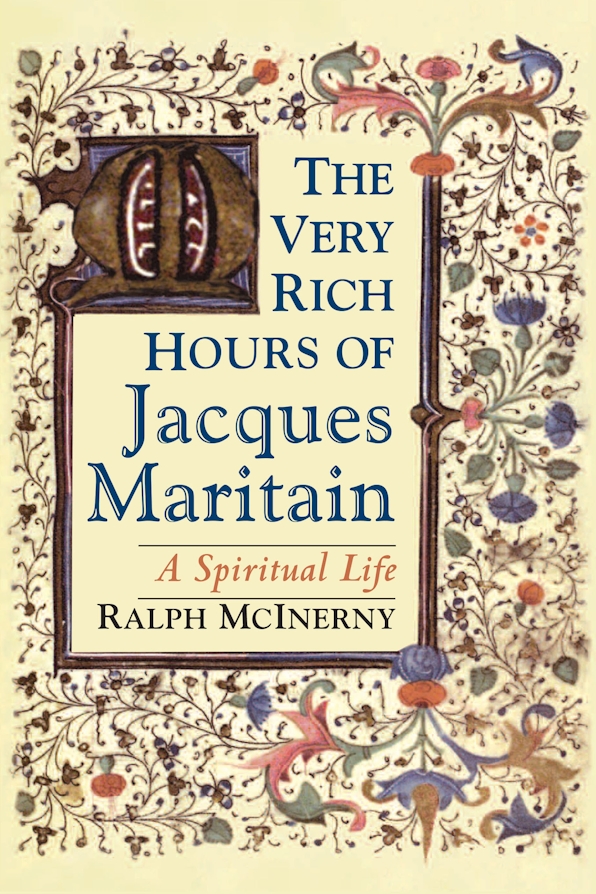
I cannot quite remember when I first stumbled into the work of Jacques Maritain, but I have dipped into his writings from time to time and always come away richer for the reading. Because of this, when I read an article recommending a spiritual biography of his life, I was intrigued and immediately picked up The Very Rich Hours of Jacques Maritain: A Spiritual Life by Ralph McInerny (2003, Notre Dame U.P., 246 pages).
What immediately stands out about McInerny’s account is the structure by which he organizes Maritain’s life according to the monastic hours (matins, lauds, prime, tierce, sext, nones, vespers, compline), a reflection of the way Maritain and his wife, Raïssa (née Oumansov), ordered their own daily lives. McInerny explicitly says his goal “is that we can find in the person of Jacques Maritain a model of the intellectual life as lived by a Christian believer” (3), and I believe he more than adequately accomplishes his aim. What drives Maritain’s life, as well as the small community he formed with his wife and her sister, is the conviction he gleaned from an early mentor, Léon Bloy: “There is only one sadness, not to be a saint” (21). This idea fueled Maritain’s life of the mind and explication of philosophical and spiritual truth, as well as his daily existence.
McInerny deftly weaves together an account of Maritain’s life: his conversion, the profound influence of his wife, his development as a philosopher and various publications, interactions with key thinkers of the day, his teaching at various universities in France, Canada, and the United States, and the concluding era of his life where, as an aged man, he took vows to join the Little Brothers of Toulouse.
While this book may be a deep cut in the minds of many, I could not help but find myself deeply encouraged in reading it. As I concluded the account of this remarkable man’s life, I found deep resonance with McInerny’s conclusion that not only would I have liked to know this man more, but even more: “How I would like to be like that! For it is a question of being as much as or more than of knowing” (211). Occupied with that goal of becoming a saint, of becoming deeply holy, Maritain strove, albeit imperfectly, to live out a sense of vocation that is at once more profound and rigorous than we usually encounter in another soul.
[1] Alasdair MacIntyre, After Virtue: A Study in Moral Virtue, 3rd ed. (Notre Dame, IN: University of Notre Dame Press, 2007), 246.
Discover more from Matthew Erickson
Subscribe to get the latest posts sent to your email.
 Matthew Erickson
Wow, I stumbled my way through this from Maritain to McInerny to MacIntyre but I do love this stuff. And now I know it’s called Aristotelianism. Fascinating. Thanks.