
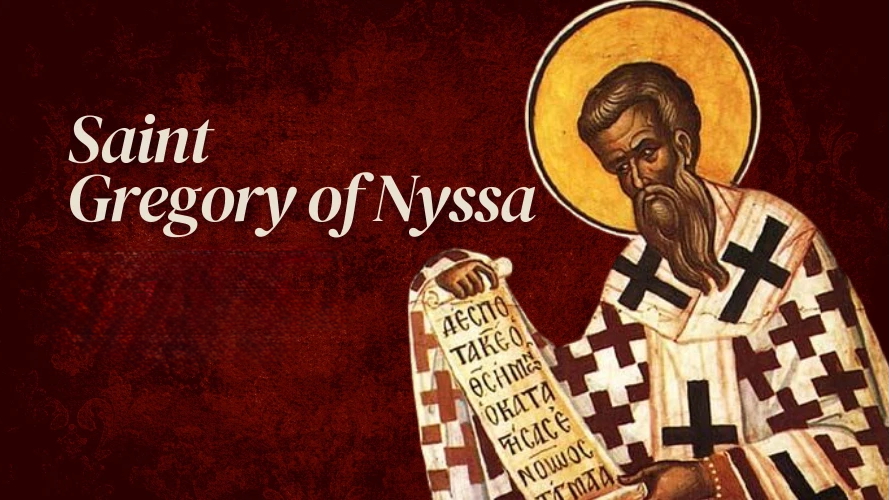
This past weekend in my message, “The Pursuit of God,” I referenced a quotation by St. Gregory of Nyssa taken from his influential work The Life of Moses:
“Once having set foot upon the ladder…he [Moses] continually climbed to the step above and never ceased to rise higher, because he always found a step higher than the one he had attained…although lifted up through such lofty experiences, he is still unsatisfied in his desire for more. He still thirsts for that with which he constantly filled himself to capacity, and he asks to attain as if he had never partaken…” (The Life of Moses II.227, 230)
Gregory of Nyssa (c. 335—c. 395) is one of the towering theologians of the church. His profound reflections wove together deep biblical insight, mystical theology, and Hellenistic philosophy. With his brother, St. Basil the Great, and their mutual friend, St. Gregory Nazianzus, Gregory of Nyssa was one of the Cappadocian Fathers of the Eastern Church whose efforts arose during the fourth century as general persecution of Christians was ending. Gregory’s influence in reflections upon the Trinity, amongst other things, has led him to increasingly become regarded, according to one source, “as the most brilliant and subtle thinker and most profound mystical teacher of the three.”
Gregory is perhaps most well-known for his work quoted above, The Life of Moses, which traces the life of Moses in Scripture as an exploration of the spiritual life. Gregory sees in Moses’ life an expression of the ascent of the human life toward God, a journey which is never ending, both in this life and in the life to come. Gregory was greatly influenced in these views by the Apostle Paul’s words:
“Not that I have already obtained all this, or have already arrived at my goal, but I press on to take hold of that for which Christ Jesus took hold of me. Brothers and sisters, I do not consider myself yet to have taken hold of it. But one thing I do: Forgetting what is behind and straining toward what is ahead, I press on toward the goal to win the prize for which God has called me heavenward in Christ Jesus.” (Philippians 3:12-14)
For Gregory, then, the spiritual life could be seen as a continual growth or straining ahead in pursuit of God. Gregory explores this idea in The Life of Moses through three stages of the spiritual ascent: 1) the Lord’s revelation of Himself to Moses first in light, 2) the Lord’s revelation of Himself to Moses next in the cloud, and 3) finally, the Lord’s revelation of Himself to Moses in the dark. This, in some ways, hints at the later writings of Pseudo-Dionysius the Areopagite, who is known for suggesting that one of the most important ways to know God is the via negativa—the way of unknowing—which was later echoed in woks like The Cloud of Unknowing.
Gregory’s work has been influential for me over the past few years, and I read quite a bit of his work while on sabbatical this past Fall. I especially enjoyed the selection of his works by Jean Danielou From Glory to Glory which, while now out of print, can be found used.
Discover more from Matthew Erickson
Subscribe to get the latest posts sent to your email.
 Matthew Erickson