
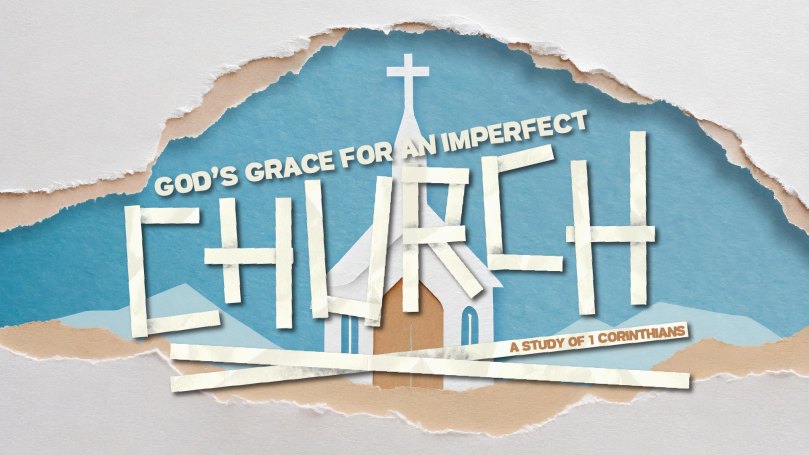
When I draw near to the end of a sermon series, I usually share resources I utilized in my study and preparation for sermons. I started doing this because people would ask me what sort of resources I leaned upon for a series or wanted to dig deeper into a specific topic. Here is the bibliography for our recent series, “God’s Grace for an Imperfect Church: 1 Corinthians.” Books with asterisks (*) are those I found particularly helpful or leaned upon in this series. I hope some of these books are as helpful for you as you explore the fascinating and sometimes difficult epistle of Paul known as 1 Corinthians.
Bibliography for “God’s Grace for an Imperfect Church: 1 Corinthians” [Summer 2025]
* Kenneth E. Bailey. Paul Through Mediterranean Eyes: Cultural Studies in 1 Corinthians. Downers Grove, IL: InterVarsity Press, 2011.
Craig L. Blomberg. 1 Corinthians. NIVAC. Grand Rapids, MI: Zondervan, 1995.
Gerald Bray, ed. 1-2 Corinthians, 2nd ed. ACC. Downers Grove, IL: InterVarsity Press, 2006.
D. A. Carson. The Cross and Christian Ministry: Leadership Lessons from 1 Corinthians. Grand Rapids, MI: Baker Books, 1993.
Roy E. Ciampa and Brian S. Rosner. The First Letter to the Corinthians. PNTC. Grand Rapids, MI: Eerdmans, 2010.
LaMoine F. DeVries. Cities of the Biblical World: An Introduction to the Archaeology, Geography, and History of Biblical Sites. Peabody, MA: Hendrickson Publishers, 1997.
* Gordon D. Fee. The First Epistle to the Corinthians, rev. ed. NICNT. Grand Rapids, MI: Eerdmans, 2014.
Scott J. Hafemann. “Corinthians, Letters to the.” In Dictionary of Paul and His Letters, edited by Gerald F. Hawthorne, Ralph P. Martin, and Daniel G. Reid, 164-179. Downers Grove, IL: InterVarsity Press, 1993.
Judith L. Kovacs, translator and editor. 1 Corinthians: Interpreted by Early Christian Commentators. The Church’s Bible, ed. Robert Louis Wilken. Grand Rapids, MI: Eerdmans, 2005.
* Wayne A. Meeks. The First Urban Christians: The Social World of the Apostle Paul. New Haven, CT: Yale University Press, 1983.
* Anthony C. Thiselton. The First Epistle to the Corinthians. NIGTC. Grand Rapids, MI: Eerdmans, 2000.
N. T. Wright. The Resurrection of the Son of God. Christian Origins and the Question of God: Volume 3. Minneapolis, MN: Fortress Press, 2003.
________. Surprised by Hope: Rethinking Heaven, the Resurrection, and the Mission of the Church. New York: HarperCollins, 2008.
________. Paul: A Biography. New York: HarperCollins, 2011.
Online resources:
- John Chrysostom’s Homilies on the Epistles of Paul to the Corinthians: https://ccel.org/ccel/schaff/npnf112/npnf112?queryID=33775666&resultID=1091
- John Calvin’s Commentaries online: https://www.ccel.org/ccel/calvin/commentaries.i.html
- Bible Project:
- 1 Corinthians
- Book of 1 Corinthians: Key Information and Helpful Resources
- New Testament Letters: Historical Context
- New Testament Letters: Literary Context
Discover more from Matthew Erickson
Subscribe to get the latest posts sent to your email.
 Matthew Erickson
An impressive list. Was the work of Kenneth Bailey especially helpful? Seeing things through his eyes usually adds freshness and relevance. You bring scholarship to your preaching. Well done, pastor.
Yes, I found Kenneth Bailey’s book very helpful. I enjoyed his “Jesus Through Middle Eastern Eyes” and this companion volume on 1 Corinthians was equally good.
While preparing my keynote address during the launch of Somali New Testament, I found Ahmed Haile’s theology of the church facinating. In “Teatime in Mogadishu”, he writes (pp.36-7):
“All nomadic Somalis have lived in houses that move whenever the family moves. That has also been the story of my life. I was already a wanderer before I met Christ, going back and forth from Mogadishu to Bulo Burte, and spending a prolonged period in Johar during the great famine.
But ever since that day when I believed in Christ, I have come home. This home is not stationary. Like the nomadic huts, my home is often on the move. But whatever the circumstances, dusty, drought of luscious pastures, when I met CXhrist I knew that he is the door into my true home.
My true home is the church. It is like a nomadic hut. The hut has ribbing and a centre pole. The centre pole is the udub. The matting of the roof is the woven reeds. It is the tol (weave). The udub is Christ crucified and risen. He is the centre and the whole house is supported by him. The pole is analogous to the cross where Jesus gave his life as a living sacrifice on the cross.
Christ crucified and risen is the creator and sustainer of the church.
We who believe are the ribbing. All ribbing comes together at the apex of the udub. All the ribs are held together anchored and supported by meeting each other at the top. Any ribbing that is not anchored to the centre pole is useless.
We are also the tol, the woven mat that is thrown over the ribbing to provide the protective roof. The Holy Spirit weaves us together in the bonds of love. the tol can also be a metaphor for the grace of Christ; so we are woven together in the grace and love of Christ who is our righteousness, our covering.
The day when I believed in and committed my life to Jesus Christ, I became a rib in the house of God, the church. That is my home, now and eternally. I have never walked with Jesus Christ alone. That would be like a rib attempting to stand upward alone or providing solitary support for the woven mat covering; that is impossible. We must always live within the fellowship of the church. In my commitment to Christ, the Holy Spirit binds me to all the other ribs and I am woven together with all the other reeds that provide a covering for the house. Within that house, I revel in the secure covering of the grace of Christ.”
Francis Omondi
Thank you so much for sharing this wonderful quotation, Francis. This is a wonderful picture of the church as “home” through Ahmed Haile’s reflections. I am so grateful you shared it!